
Prediction Markets vs. Sportsbooks: What Every Bettor Should Know
What Is a Prediction Market?
A prediction market is a platform where people buy and sell shares on the outcome of a future event. Instead of placing a traditional bet, you're trading contracts. Each contract pays out $1 if a specific outcome occurs, and $0 if it doesn't.
The two biggest prediction markets right now are Kalshi and Polymarket. Kalshi is federally regulated in the US by the CFTC. Polymarket runs on blockchain technology and has historically been more accessible internationally.
How Prices Are Set
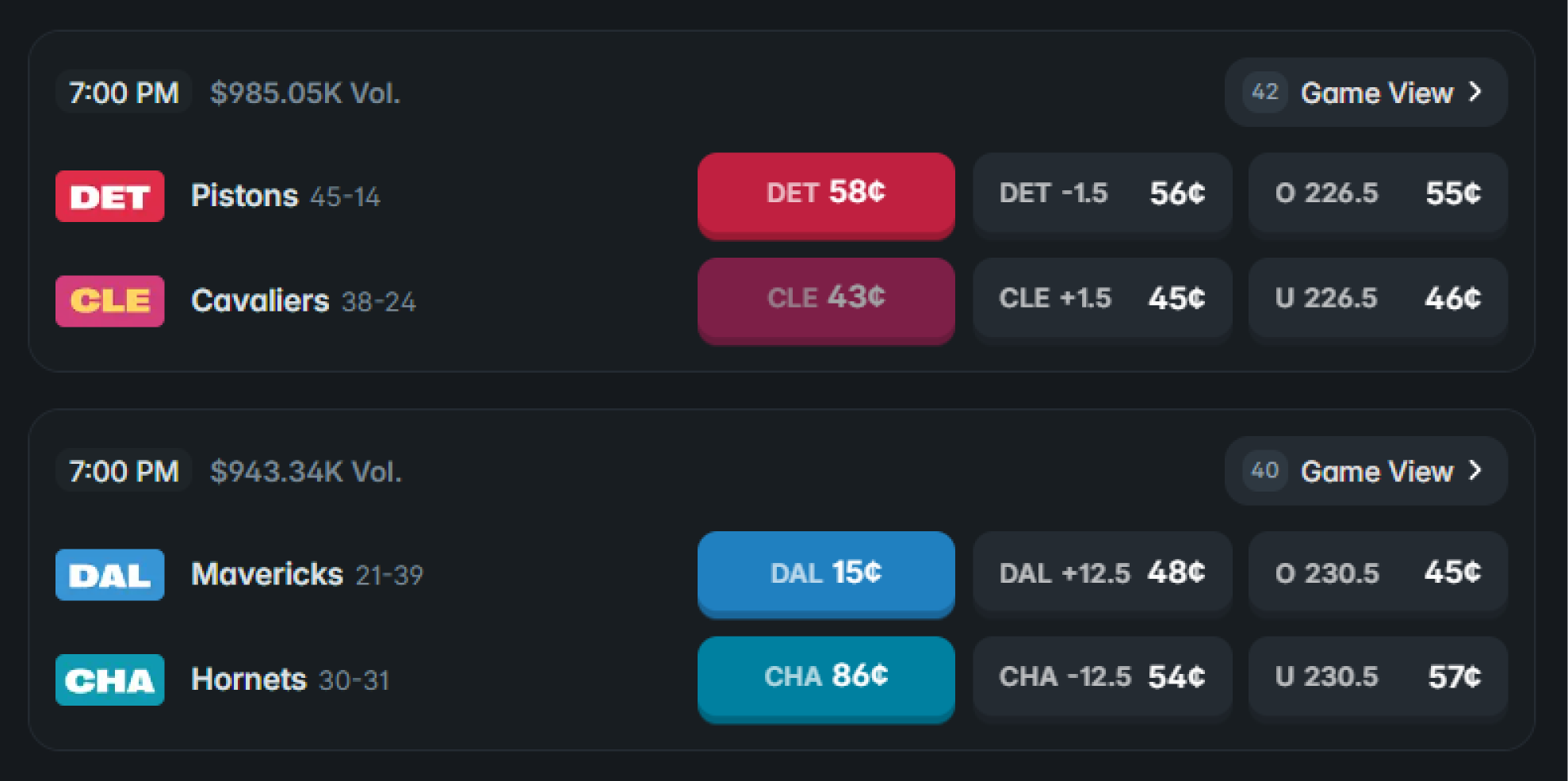
This is the key difference between prediction markets and sportsbooks. The price is set by the crowd.
If a contract is trading at $0.65, the market collectively believes there's a 65% chance that outcome happens. No bookmaker is setting that number. Buyers and sellers are negotiating it in real time, the same way stocks are priced on an exchange.
If you think the true probability is 75% but the market says 65%, you buy contracts at $0.65 and profit if you're right. You can use our Prediction Market Converter to convert between contract prices and traditional odds formats. The price moves constantly as new information comes in and traders take positions. This is called a peer-to-peer model. You're not betting against the house, you're betting against other traders.
How Prediction Markets Make Money
Because it's peer-to-peer, the platform doesn't take on any risk. Kalshi charges a fee based on the size and odds of your position. Polymarket charges 0% on most markets, with small fees on select market types. The platform makes money on trading volume regardless of who wins or loses.
How Sportsbooks Work
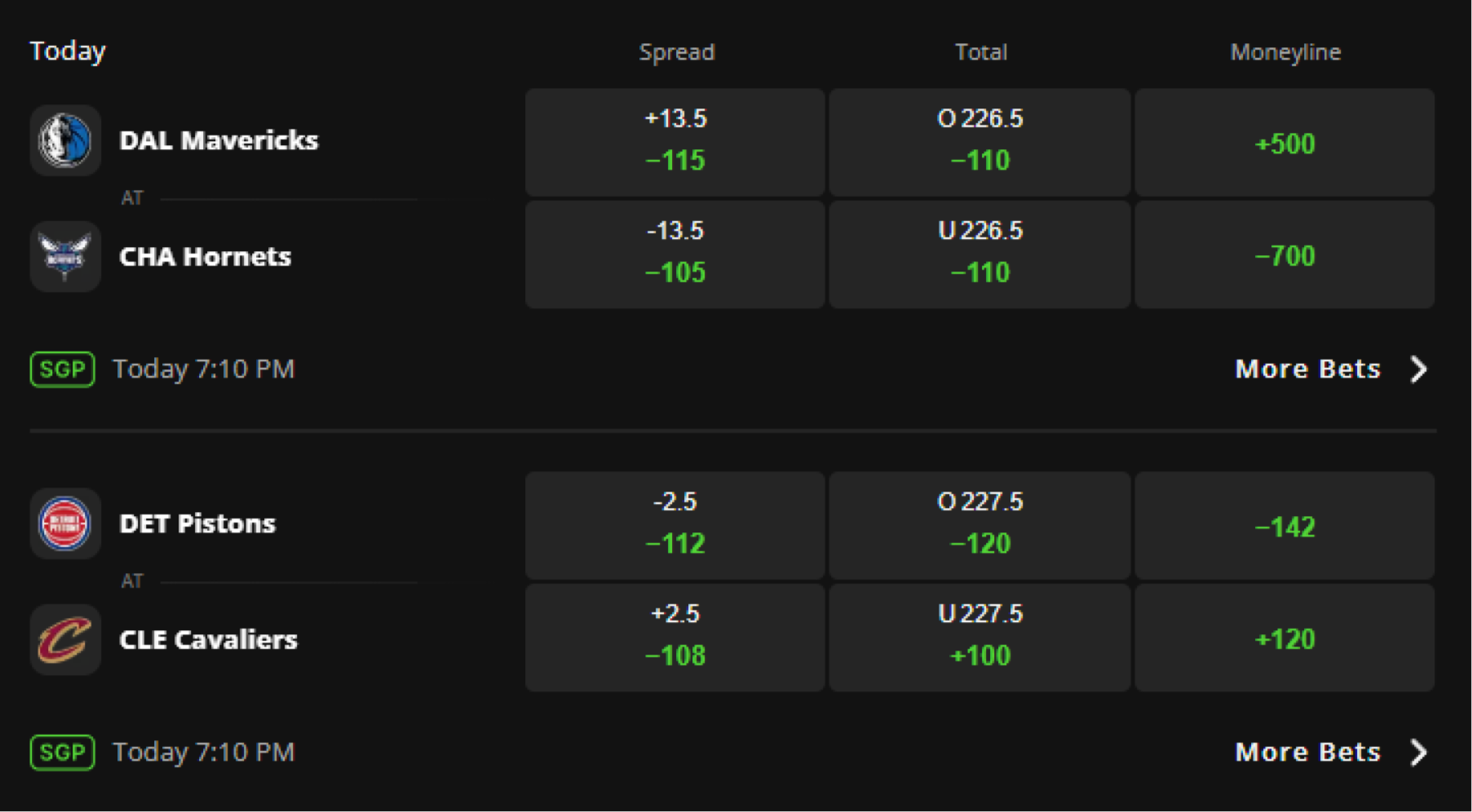
Sportsbooks operate on a fundamentally different model. You're betting against the house, not against other traders. The sportsbook sets the lines, accepts your bet, and pays you out if you win using their own money.
How Lines Are Set
Most major sportsbooks use a combination of oddsmakers and algorithms to set opening lines. They factor in things like historical data, injury reports, and weather. From there, lines shift based on incoming action.
Not all sportsbooks set lines the same way though. Sharp books like Pinnacle and Circa set tight, accurate lines and actually welcome sharp action because they use it to refine their numbers. They make money on volume with a low margin. Square books like DraftKings, FanDuel, and BetMGM set lines with more margin built in, rely heavily on recreational bettors, and are quick to limit or restrict winning players. Yes, the books that advertise the most are also the ones most eager to show you the door once you start winning.
How Sportsbooks Make Money
The core mechanism is the vig, also called juice or margin. When you bet -110 on both sides of a game, the book collects more than it pays out regardless of the result. On a standard -110 line, the vig is roughly 4.76%, meaning for every $100 wagered, the book keeps about $4.76 in the long run. It doesn't sound like much until you do the math over thousands of bets. Use our Vig Calculator to see exactly how much margin is built into any line.
The Sharp Bettor's Perspective
Vig Comparison: Which Is Cheaper to Bet Into?
This is one of the most overlooked factors for serious bettors. Every time you place a bet, the vig is working against you. Over thousands of bets, even a 1% difference in margin has a massive impact on your bottom line. Here's how the major platforms compare:
| Platform | Typical Margin |
|---|---|
| Polymarket | 0% (most markets) / up to 0.44% on select markets |
| Kalshi | 1.2% average |
| Sharp Books - e.g. Pinnacle | 2.5–5% |
| Square Books - e.g. DraftKings, FanDuel | 4.5–7% |
| Sportsbook Props and Smaller Markets | 4.5–10% |
Betting into a 7% margin book means you need to win at a significantly higher rate just to break even. The difference between betting at Polymarket and betting at a square book isn't small. It compounds dramatically over time. For a serious bettor, where you place your action matters just as much as which side you're on.
Where Lines Are More Accurate and How to Exploit the Gap
Sharp sportsbooks like Pinnacle are widely considered to have some of the most accurate lines in the world. They actively welcome sharp money and update their lines accordingly, making the line essentially a consensus of the smartest bettors in the market.
Prediction markets are also efficient, but in a different way. Because anyone can trade them, they incorporate a wide range of information. The tradeoff is that they can be slower to react to sports-specific information like late injury news or significant line movement at sharp books.
That lag is where the opportunity lives. If Pinnacle moves a line significantly due to sharp action and Kalshi or Polymarket hasn't caught up yet, there's a window. This happens more than you'd think, particularly on player props and game-specific markets, and it's essentially a form of arbitrage between two different pricing systems.
Account Longevity and Bet Sizing: Who Limits You Faster?
Ask any winning sports bettor what their biggest frustration is and the answer is almost always the same... bet limits.
At square sportsbooks like DraftKings, FanDuel, BetMGM, and Bet99, winning consistently triggers risk flags. Each book has its own internal formula for identifying sharp bettors. Some track your closing line value, some monitor win rate over a sample, some flag certain bet types. The exact methodology varies by book and none of them publish it. The outcome is always the same though. Your maximum bet size gets slashed. A player who once had $10,000 limits suddenly finds themselves capped at $100 or $200 on certain markets. You're still allowed to bet, they just make it nearly impossible to generate meaningful profit.
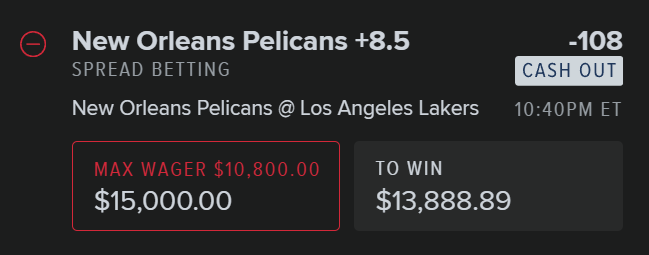
$10,800 max wager on an account that is not limited
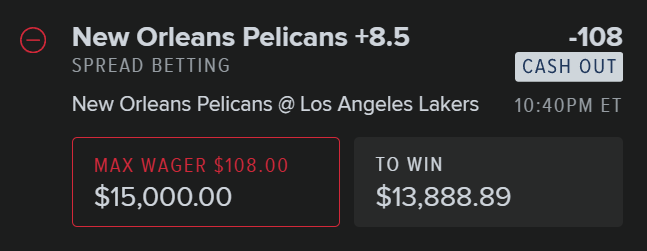
$108 max wager on an account that is limited
At sharp books like Pinnacle, the model is different. They're built to take sharp action and use it to sharpen their lines. They publish the same maximum bet limits for everyone, sharp or recreational, and they won't cut you off or reduce your limits for winning. It's a level playing field by design.
Prediction markets operate on an entirely different level. Because you're trading against other participants in an open market, there is no bookmaker deciding whether or not to accept your action. You can get down as much as the market has available. If there's $50,000 worth of contracts available at a price you like, you can buy all $50,000 worth. The platform makes its money on trading volume regardless of who wins, so sharp traders are actually welcomed. The ceiling on your action is the size of the market itself, not an arbitrary limit set by a risk manager who flagged your account.
Geographic Restrictions: Where Can You Actually Use These Platforms?
The regulatory landscape for prediction markets is still evolving and where you live has an impact on what's available to you.
Kalshi is federally regulated by the CFTC and available to US residents, but is not available in Canada. Polymarket has two separate products. The global version, which is the larger and more established platform, blocks US users entirely. The US version is a separate regulated exchange that launched in late 2025 after Polymarket acquired a CFTC-licensed exchange for $112 million and received federal approval to relaunch in the American market. As of early 2026 the US version is still rolling out through a waitlist and is not yet widely accessible.
For Canadian bettors, the prediction market space hasn't fully opened up yet. On the sportsbook side however, the options are plentiful, though the landscape varies significantly by province. Ontario is the only province with a fully regulated private sportsbook market, where over 30 operators including DraftKings, FanDuel, BetMGM, Bet365, and Caesars are fully licensed. Alberta passed legislation in 2025 to open a competitive private market of its own, with a launch expected in early 2026. Every other province operates under a government-run monopoly. BC has PlayNow, Quebec has Mise-O-Jeu, and the prairie provinces have Sport Select. Private sportsbooks do operate in those provinces in a grey market capacity, but they are not provincially regulated.
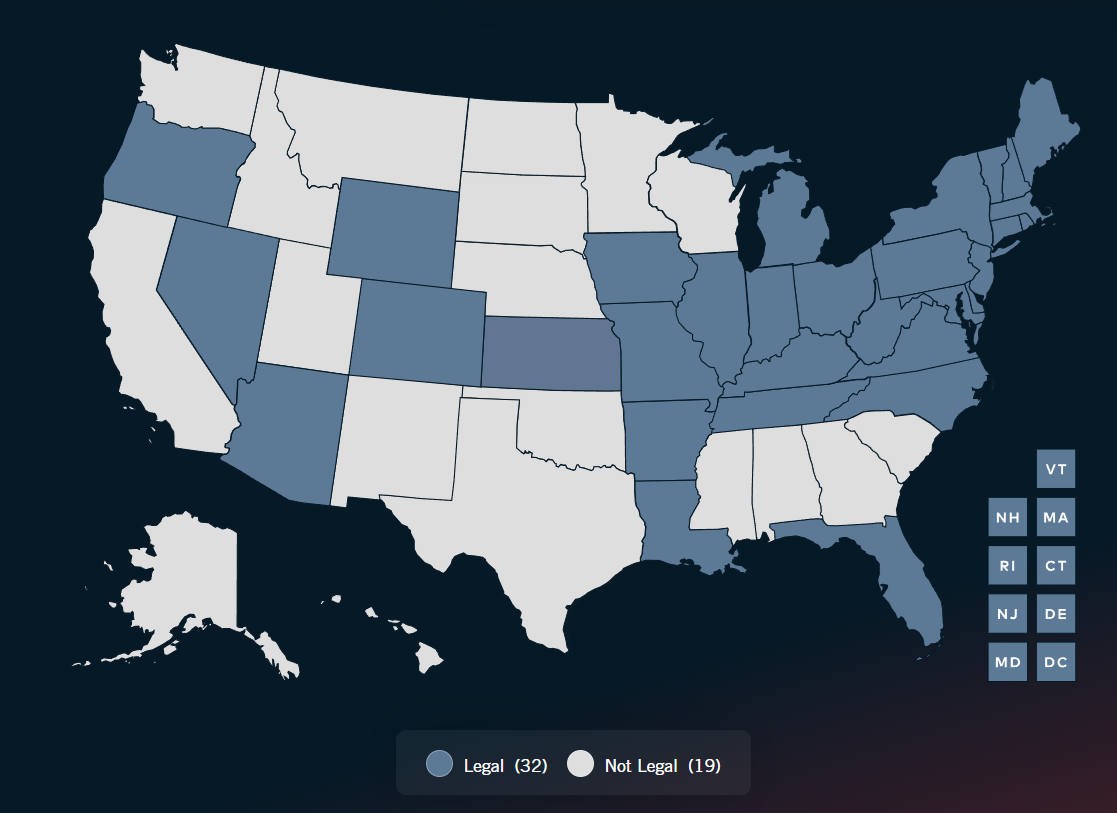
In the US, legal sports betting is now live in the majority of states but still blocked in several, and the state by state regulation means a book available in New Jersey might not be accessible in Florida.
Who Should Use What?
Not every bettor has the same goals, bankroll, or risk tolerance, and the right mix of platforms depends heavily on where you are in your betting journey.
The recreational bettor is best served sticking with the major sportsbooks they already know. DraftKings, FanDuel, and similar apps are built for casual use with easy deposits, clean interfaces, and plenty of promotions to take advantage of early on. Prediction markets aren't worth the learning curve until you have a solid foundation in how odds and probability work.
The serious or professional bettor should absolutely be incorporating prediction markets into their toolkit, particularly when sportsbook accounts are already restricted. At this level, having more places to get action down is one of the most valuable edges you can have. We offer 1-on-1 coaching if you want help building a strategy around your specific situation.
The Future: Prediction Markets vs. Sportsbooks
This is where things get interesting, and the next few years could reshape the entire betting landscape.
In 2024, Kalshi successfully fought the CFTC in court over its event contracts, paving the way for the company to launch sports markets in early 2025. This opened the door for a federally regulated, nationwide sports betting alternative that operates completely outside the state by state sportsbook framework. A sharp bettor in a state where traditional sports betting is still illegal could theoretically access sports markets through Kalshi legally, because it is regulated at the federal level rather than the state level.
As prediction markets grow in liquidity and expand their sports offerings, they become an increasingly viable alternative to traditional sportsbooks rather than just a supplement. For sharp bettors especially, the combination of no account restrictions, peer to peer pricing, and lower vig makes prediction markets structurally superior in almost every way except one: liquidity. Right now you simply cannot get the volume of money down on prediction markets that you can at major sportsbooks. But liquidity follows volume, and volume follows awareness. As more sharp bettors migrate toward prediction markets, liquidity will grow, and as liquidity grows more sharp bettors will follow.
The threat to sportsbooks is real but not immediate. Casual bettors aren't going to trade contracts on Kalshi instead of placing a quick parlay on DraftKings. Serious bettors will likely split their action across sharp books and prediction markets based on where the best price and liquidity exists for any given market. Perhaps the most telling sign of where things are headed is what the sportsbooks themselves are doing. DraftKings, FanDuel, and Fanatics all launched their own prediction market apps in late 2025, effectively acknowledging that the model is here to stay. When the incumbents start building the thing that is supposed to replace them, that tells you everything you need to know about where the industry is going.
The Bottom Line
Prediction markets and sportsbooks each have their place. They're different tools, and the sharpest bettors will eventually use both. Sportsbooks offer depth, variety, and liquidity that prediction markets can't match yet. Prediction markets offer fairness, lower vig, and a level playing field that sportsbooks will never offer by design.
Here's how they stack up across the factors that matter most:
| Factor | Prediction Markets | Sharp Books | Square Books |
|---|---|---|---|
| Vig / Margin | 0–1.2% | 2.5–5% | 4.5–7% |
| Account Restrictions | None | None | Common for winners |
| Bet Sizing | Limited by market liquidity | Same limits for everyone | Slashed for winning players |
| Line Accuracy | High (crowd-driven) | Very high | Moderate |
| Sports Coverage | Limited but growing | Extensive | Extensive |
| Availability | Mostly US (limited in Canada) | Global | Varies by region |
| Best For | Sharp, experienced bettors | All levels | All levels |
The trajectory is clear. Prediction markets are growing, liquidity is improving, and the regulatory landscape is shifting in their favor. For bettors who are serious about long-term profitability, ignoring them isn't really an option anymore.
The bettors who will thrive over the next decade are the ones who understand both worlds and know how to navigate each one strategically. That is exactly what OddsAnchor is built to help you do.
This article was written in February 2026. The prediction market space is evolving quickly and some details may have changed since publication.